
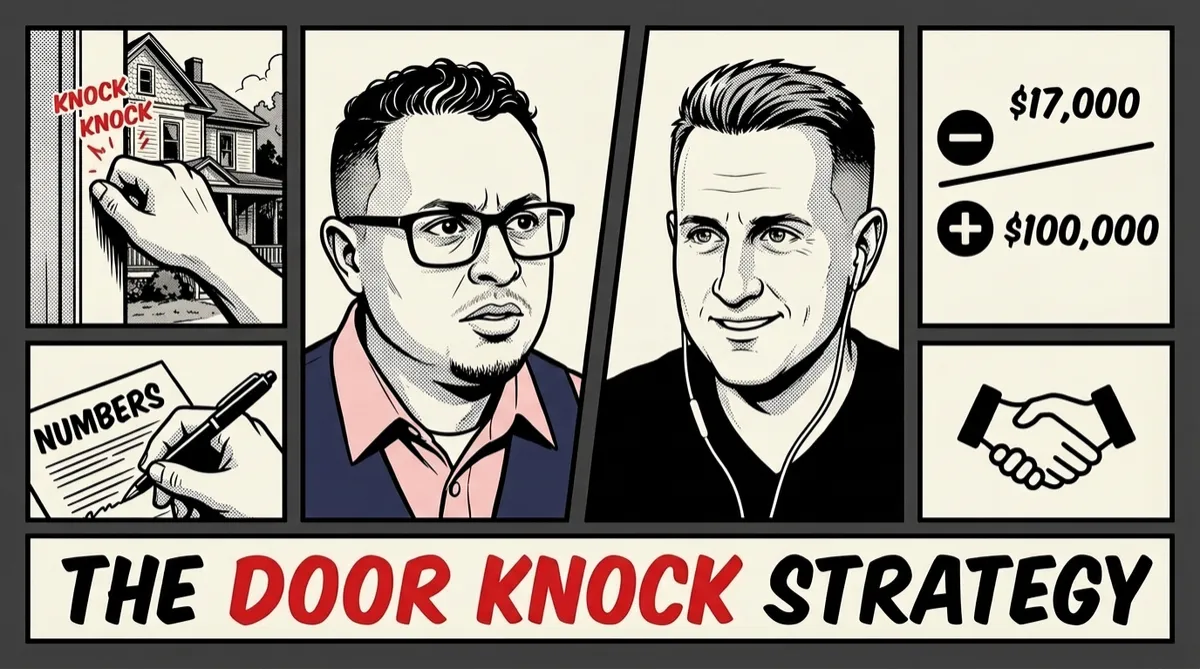
How a $17K Real Estate Deal Became $83K in 35 Days
I've known Taylor Walls for years. The first time we met, he took one look at my tires and told me they were about to blow. I went straight to the tire shop that day.
That's Taylor. He notices things other people miss.
So when he told me about his first active real estate deal on Money Behind the Deal, I wasn't surprised it was a wild one. Two houses. Just under $17,000. A $100,000 sale about 35 days later.
Here's how it happened, and what you can learn from it if you're hunting for your first deal.
Who is Taylor Walls?
Taylor grew up farming, so hard work was just part of life. Even as a kid, he didn't want a job that paid just enough to keep him broke.
He made the dean's list in engineering, then dropped out. The business owners he admired most never went to college, including a guy he helped flip houses back in high school.
He built a long career in financial services. He invested passively in real estate for a while. Then his family grew, they decided to build a home, and he needed bigger paydays. That's when he stepped into real estate actively.
The $17,000 deal that paid $83,000
Taylor heard about a newer auction website. It was only running a few sales a month, and most investors didn't know about it yet.
On it, he found two houses sitting on side-by-side parcels. Nobody had been inside either one. A relative lived in one house. The other was empty.
A seasoned investor might have seen red flags everywhere. Taylor admits he was just naive enough to go for it.
He got in touch with the person living there before the auction. He bought both houses for just under $17,000, because nobody else was bidding.
Then he helped the lady move out. He didn't touch the properties. Within a couple of weeks of the houses going into his company's name, he sold them both to an investor who wanted them as rentals. One went for $40,000 and the other for $60,000.
That's $100,000 total and an $83,000 spread, in about 35 days. And Taylor has never seen those houses in person.
Not every deal is a unicorn
Taylor is honest about this. That first deal was a unicorn. Most deals don't pay like that.
But they can still pay well. A later flip of his made $63,000. These aren't luxury homes either. They're everyday houses.
The real lesson from the first deal wasn't the money. It was proof that it's possible. Once you get past the fear, real estate becomes a numbers game.
He also credits his partner, a wholesaler who mentored him and gave him the basic tools up front without expecting anything back.
Watch the full conversation
Taylor tells this story way better than I can type it. Hit play to hear the whole thing, including his V8 engine analogy for why he flips instead of renting.
Now let's get into how he thinks about deals.
Leave your emotions at the door
On Taylor's first real flip, every tiny paint blend and drywall flaw drove him nuts. A realtor who invests a lot told him to let it go. The buyer of that house wasn't expecting the finishes of Taylor's own home.
Now he runs every deal by the numbers. If he feels emotionally attached, he walks away.
I learned this one personally. We rented out our family home, the one my parents built. When we came back, little things like stickers on the walls bothered us way more than they should have. That's what emotional attachment does. It turns small things into big decisions.
The one thing that does scare Taylor off a deal? A bad foundation. There are too many good houses out there to take that on.
Flip or hold? Taylor's V8 analogy
Right now, Taylor flips, wholesales, and wholetails. He isn't holding single-family rentals. In his areas, evictions are high and tough tenants are common.
When he does hold, he wants multifamily. He explains it like an engine:
A V8 with one bad cylinder still runs. You feel it, but you keep going.
A four-cylinder with one bad cylinder needs to pull over.
A two-cylinder motorcycle with one bad cylinder isn't going anywhere.
One bad tenant in a single-family rental shuts down your income. One bad tenant in a bigger building is just a misfire.
There's no wrong answer here. Some investors love single-family rentals because tenants stay longer. It comes down to your goals and how much risk you can handle.
How to find your first deal from scratch
I asked Taylor what he'd do if he lost everything and needed a deal fast. His answer: knock on doors.
Homeowners facing foreclosure get flooded with calls and texts. After a while, every caller sounds the same. Showing up in person sets you apart.
Here's his plan:
Find distressed properties. Search auction sites using Google, ChatGPT, or Claude. Pull the addresses.
Look for spread. Compare what's owed in mortgage or taxes to what the house is worth.
Map a short list. Pick a group of houses close to each other so you can knock them in one afternoon.
Knock. Introduce yourself and ask questions.
Get it under contract. Then sell it to an investor for a small markup, or bring in a partner to flip it.
It helps to look approachable. Taylor drives a red Toyota Sienna. Nobody feels threatened by a family minivan.
And trust your gut. If a house or situation feels unsafe, skip it and go to the next one.
How to talk to sellers
Taylor usually has a rough price in mind before he knocks. He looks up the owner, checks if an auction date is coming, and estimates the ARV.
At the door, he asks two simple questions: How much do you owe? What do you want for it?
If their number doesn't work, he walks them through how investors calculate offers. Many sellers facing foreclosure would rather sell on their own terms than have a foreclosure on their record.
If they're open to it, he asks to walk the house and take photos. Investors need pictures before they'll commit.
How to estimate ARV
ARV means after repair value. It's what the house should sell for once the work is done. Here's how Taylor gets there:
Pull comps. He uses PropStream. If you don't want to pay for software, use Zillow and filter for recently sold homes nearby.
Compare layouts. Check what similar homes sold for, and what they'd sell for with an added bathroom.
Use AI for a range. He runs numbers in Claude and ChatGPT to get a low end, a high end, and a defensible ARV he can back up.
Stay on the low side. It keeps you safe.
Then work backward. Take the ARV, subtract the profit an investor needs, the rehab cost, and the holding and financing costs. Then subtract your own fee. What's left is the price you should get the house under contract for.
Build your buyers list with one post
Once you have a deal under contract, post it in local real estate investor groups. Share the area, beds, baths, and ARV, but not the exact address. Otherwise someone may try to go around you.
Message everyone who comments. Save their contact info. One post can give you a solid list of buyers for your next deal.
Taylor's advice for beginners: risk looking stupid
Taylor has spent years in financial services. He's trained a lot of people. But in real estate, he felt like a beginner again.
On one deal, he started an eviction process too early. An attorney told him he'd jumped the gun. That's how you learn.
His advice:
Ask the questions, even the ones that feel dumb
Find mentors who've been doing this for decades and still have a great family life
Join local real estate groups
Learn the difference between bank loans, hard money, and investor money
Talk to a lender about what you need, not a coworker who's never done a deal
And above all, take action. Taylor says the only way to fail in this business is to stop hustling for the next deal.
Frequently asked questions
How do I find my first real estate deal?
Start with distressed properties. Search auction sites and pre foreclosure lists, look for houses with enough spread, and reach out directly. Knocking on doors can set you apart from investors who only call.
Does door knocking work for real estate investing?
It can. Homeowners facing foreclosure often get flooded with calls, so showing up in person can stand out. Always be respectful, stay safe, and follow your state's rules.
How do I calculate ARV?
Pull recent sales of similar homes nearby using a tool like PropStream or Zillow's recently sold filter. Use the low end of the range to stay safe.
Do I need good credit to start investing?
It depends on your strategy. Wholesaling relies more on finding deals than on credit. If you plan to flip, talk to a lender about what you'll need.
Should I flip houses or hold rentals?
It depends on your goals, your market, and how much risk you can handle. Flipping brings bigger chunks of cash. Rentals bring monthly income.
Ready for your first deal?
Whether you're knocking your first door or lining up funding for your next flip, I'd love to help.